
Animation is another method used to visually express the emotions through moving hand drawn images. It is widely recognised from everyone across the world by them experiencing it through cartoon TV shows to animated feature films. Animated content is not just made for a younger audience, but it can include some elements that even adults can enjoy. Every animation company are always looking out for fresh and talented people who can connect with audience in meaningful ways. There is a high demand for animators who are skilled in storytelling and specialising in animation, opportunities in this field continue to thrive and expand throughout the industry. As if now, there has been some difficulties in finding a resource aimed at providing the skills to necessary become a successful animator. There are various methods to creating great stories for animation. whether that it is based on creating character-based narrative or a short experimental film for festivals. I can also vary to advertisement for television to on online websites, or even a motion graphics title sequence intended for success in storytelling.
Pre-Production
There are limitless possibilities for animation’s storytelling medium. Artist are free to express and create their envisioned worlds. Such as defining gravity, switching between from factual to fantasy and investing audience by transporting them to place that they would have never imagined. Animation industries need to go through various stages of pre-production before they can start animating. It all about planning the storytelling elements for animation. There are 3 essential step to doing this; Concept development, previsualization and asset building.
Concept Development
Concept development always needs to start of with a creative brief on what the project is going to be. When working with a client, you will most likely be given a creative brief for your project. Such as high-budget film trailers and adverts for TV. The documents to the brief should explain the client’s objectives, target audience and milestone deadlines. Corporate cultures have had a reputation on not getting everything right, but are eager to board with the project. Creative employees and clients are forced to be working along together to achieve success. If a creative person is not working a client, then they are recommended to write their own creative brief. Writing a creative brief must involve some important objectives for the project.
- What is it about?
- What its target audience?
- How long will it be?
- What its objective?
- When is the deadline?
When working with a client, the employee will likely come up with an idea that follows along with the briefs instructions. They will narrow down the good ideas and scripts and use them for the production process for their story related project. The story will need to include tone and theme that serves towards the plot and characters.
What I have learnt from this information is how to create a detailed creative brief for a projects’s concept. I compared it to my project idea and I though that I could write my own brief based from the concept development research. My project brief will written in my own words.
Previsualization
After the director/writer is confident with the story idea, they are ready to move on to the next stage called previsualization or previs for short. This is referred to as visual development or concept art. This stage is known to help define the look and feel of the idea before production begins. Previsualization will range from simple sketches to fully rendered characters and background set pieces. This stage both solidifies design direction and also establishes animation techniques and methods. This will give various opportunities to experiment with visual directions, materials and finally animation.
Influences to Previsualization
Most likely, art directors and animators will always be influenced from other artists work. They already may know on how they want their idea to look and feel, but still look at artists to see how they have done their own work. This influence can involve looking at lots of art illustrations as well as watching animated shorts and motion graphic videos. This is good research for animators and artists to be inspired, which motivates them to use this influence and implement it into their own original work. Artists and animators constantly need to look at good references for influenced before creating something completely original. The research will likely appeal towards visual rhythm or story structure that feels right, resulting to a stronger impact to the animated project.
What I liked about the Previsualization research is that artist always need to be influence from other artist’s work. I noticed that this is a good influence for them while they are working on their project. I will reflect on this example by also looking at other artists work and animations for my own research. I will use this influenced research to help me develop ideas for my project work.
Asset Building
Assets are all the tools and pieces that an animator needs to begin the animation process. For example, they can range from logos, character designs, background set-pieces, colour, Sound FXs and more. Animators use these kind of assets for creative purposes in animation projects. Assets is a great way for animators to build and create an organisation system along with marked files.
This research was useful on what assets that you will need to support the vision and branding towards your project. I thought it more effective by discussing on what tools you would need to create your project’s assets. Though I will take this research example on assets and apply it towards my own creative process.
Storyboarding
Storyboarding has always been a high priority for animation studios to explain their stories through visual based drawings. This is the most demanding field for artists to produce sketches that tell a detailed and quality story and characters.

”At our studio we don’t write our stories, we draw them.” (Walt Disney) (Medium, 2019).
Walt Disney is good example for this, he was known for various innovations in the animation and motion graphics field. But he most useful in contributing in pinning up a series of rough sketches in sequence to help explain the story’s idea towards his team. Animation is known for its highly time consuming and expensive process, any mistake can prove to be very costly. Storyboards are main form of communication that a studio sent to other studios across various countries throughout the production process. Storyboard artist are hired to do this job through a two year time basis, working along with other artists on films, advertising and and cartoons.
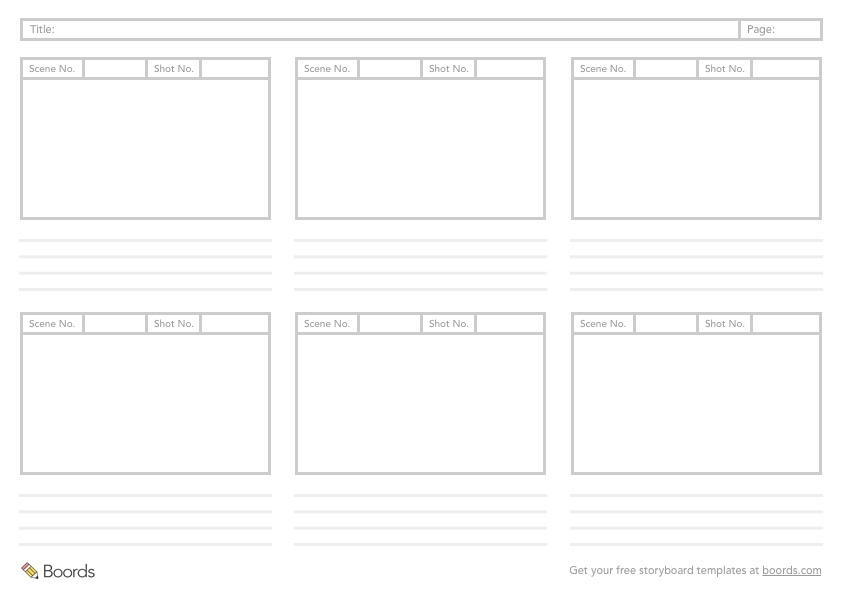
(Boords.com, 2019)
A storyboard template shows how much detail will be involved in every aspect of animation. The presentation includes spaced frames, text, transitions and timing sequences. Each frame segment will present the character’s actions and the background set-piece. Underneath each frame will be the dialogue boxes that show the text lines of what one or more characters have to say within the situation. The scene and time number visually tells how the narrative will progress chronologically.
Storyboards for Animation


(Floobynooby.com, 2019)
As soon as the character designs are finalized, the storyboard artist is next to help bring the characters to life for first time. The drawings will look rough, but is where the real story development begins.
I thought that this research was effective in describing how storyboards are structured and serves an important role for animation. This will encourage me to learn to create my own narrative structure for my project’s storyboard.
Characterisation
Characterization defines a literary device of step by step uses to explain the highlighted details about the character featured within its story. Through its initial stage the writer introduces the character through noticeable entrances. Soon after the character is introduced, the writers next step is to flesh out the character through his or her behaviour and progression throughout the story. Characters also need to be written in a way on how they can express their opinions and ideas by interacting with other characters through conversations. The final step to this is to write on how others in the story will respond to the character’s personality.
Character Methods
How they look
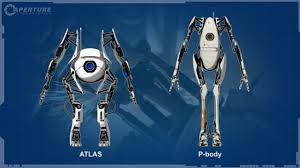
There are a variety of characters that have their own unique physical appearance in design methods. Such as a character will appear to be tall and thin or either short and round. A good example of this discretion would be the two characters, ATLAS and P-body from a game called Portal 2. A character’s looks can also be described on what hair colour they have or what clothing they wear. How a character dresses will likely reveal some aspects about that character, for example does he or she wear dirty, poor clothing or clean, stylish clothing.
I found this to be quite interesting on how designs can be visually important to a character. It was effective in showing how the physical appearance of body proportions, clothing and hair colour can tell us their backstory through visual points. This knowledge will definitely be applied to my projects character concept art.
How they Behave

(mylittlebookblog, 2019)
A action from a character can visually tell us a lot about him/her, when a character expresses their behaviour of his and her attitude. Is the character good or evil? Will the character be helpful or selfish to others.
How they sound
How a character sounds when the character speaks can also define their personality. Wether that they speak in a shy, quiet or nervous manner, or characters that have either a loud, rude and aggressive manner to them. There are also characters that have more positive qualities to them such as being friendly, approachable, confident and possibly even be intelligent.
How They Move
Depending on what the character is, wether it is a human, creature or even a robot, their anatomical structure will be build different to each other.

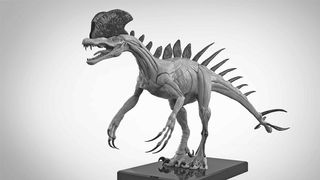
(Pollack et al., 2019)
(Pinterest, 2019)
The human’s body has been built to stand up straight because of the bone structure vertically aligned on top of each other. As for creatures like and animals and dinosaurs, their body’s bone structure has both vertical and horizontal elements. For example, starting with the creatures head vertically leading down to the tail and the digitigrade legs horizontally lead down to the feet. Some characters will be designed to include some elements from both types of anatomical structures, which results in anthropomorphic characters.
I not only just learned more about how characters should look, but how their movements and voice fit along with the design. I thought it tells a lot about what the personality should be like for a human or even creature based character. This will be important for design, animation and sound FX purposes for my project.
Types of Characterization
Direct or Explicit
This type of characterization is more direct in approach towards building the character. This method is known for using another character, narrator and even the protagonist him or herself to tell the reader and other audience groups about the subject.
Indirect or Implicit
The method introduces the character in a more subtle way towards an audience. An audience feels that they have to deduce themselves for the characteristics of that character. Such as observing its behaviour, speech, personality, appearance and manner of communication and also discerning the response towards other characters.
I thought that this information was straight forward and easy to learn about writing characters towards an audience. It also made me learn on how to build and observe a characters appearance, behaviour and communication to others through a direct and indirect approach. These elements will be important for me to reflect on by writing this method to help develop my own characters.
Deconstructing Storytelling On An Animated Short (The Tree)
The Tree’s story takes place in a post apocalyptic world where an old man spends his days collecting water to quench the thirst of a dead tree.
Act 1


Every day, a surviving old man climbs up a sandhill to gather as much water as he can from the water dispenser. He is willing to put in all his strength as effort in getting many drops of water as he can before nightfall. He uses his slay to slide back down from the hill to his home where the dead tree lays next to. He proceeds to pour nearly all the water for the tree, leaving only a drop to consume for himself. There are a few questions within this 1st act.
- Who is this man?
- Does he live alone?
- Why does he care about the tree more than himself?
Act 2


In the 2nd act, all these questions are later answered through a flash back. The old man was once a father who had a daughter that was constantly coughing, presuming that she was ill. His daughter still had a high character spirit by drawing a bright colourful green tree, envisioning its beauty by wanting to seeing a real one living. The father gathers water for his sick daughter to drink, hoping that it will recover her. He later acknowledges her tree drawing and pauses to think about wether he can make daughter’s dream come true.


The next morning, the father goes out to the wasteland to see if he can find a way to create a tree for his daughter. He makes a tree from a large dead stick piece and tears up his own green scarf for the leaves. He later brings the tree home to his daughter, she was pleasantly surprised to see a young real life tree, but the dad and the audience know otherwise. The daughter proceeds to care and look after the tree by giving it some water. The father seemed worried about it first, but was okay with it as long as the daughter drank some water too. The hints towards messages about sharing, caring for other life and making someones dream come true.
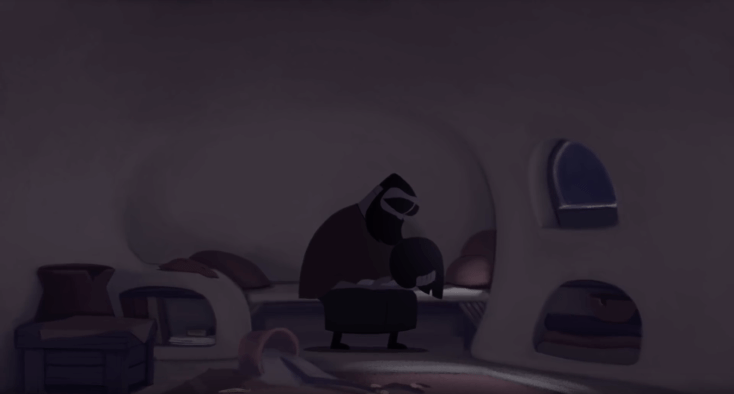
The second act later ends on emotional scene were daughter succumbs to her illness, which resulted to the father’s loss of his only daughter.
The 2nd act parallels to the man’s actions on why he is looking after the tree more than himself in the 1st act. The tree is the only living memory of his daughter to remember by. So he keeps on giving the tree more water mainly to fulfil his deceased daughters dream of a more positive world with life.
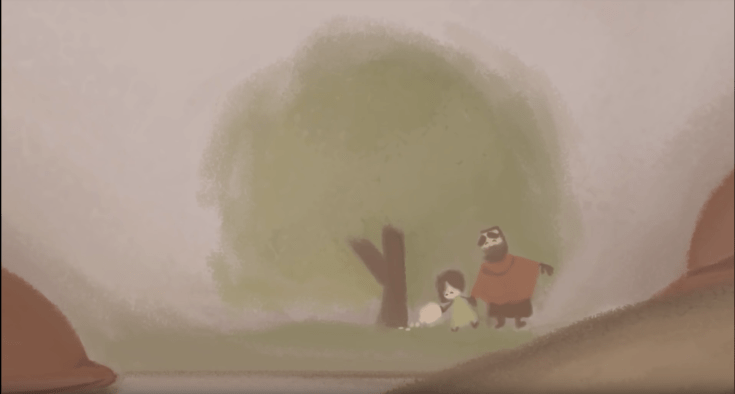
Act 3


This act starts back with the father in his present and older state doing his normal daily routine by getting the water for the tree. He is later met by an unfortunate even from an oncoming sandstorm, he quickly goes back to his home to protect the tree from it.
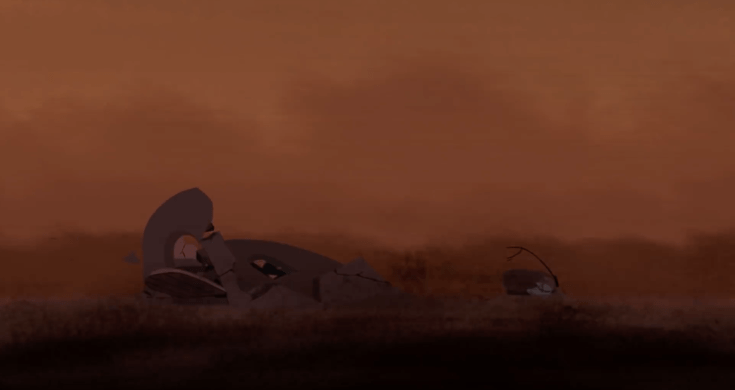
The father tries to build a fort from his bed in order to protect the tree, but it was useless against the sandstorm. The father was willing to go protect the tree himself, to go as far to lose his home and even sacrifice his own life for the tree.


The father does indeed die from his actions, but he is greeted by his daughter who has grown up in her own Heaven where the tree is also fully grown, too. The father and his daughter finally live together again in the afterlife. The final 2 frames parallel from each other, insuring that the buried father successfully protected the dead tree to keep his daughters vision alive.
The message of this animated short is about treasuring the memorise of the close loved ones that you once cared in your life.
Reflection
After watching this animated short, I learned more about how visual storytelling can have massive psychological impact on us. It allows us to think and try to figure out the events happening on screen throughout. Visuals can make us feel the emotions expressed through colours and characters actions instead of words (show not tell). It was effective for me to learn how a story should be structured throughout the 3 acts. Act 1 sets up the questions, act 2 reveals the answers and act 3 connects the story element together for the climax. It effectively shows the aspect on the story being focused on the main character is likely to immerse the audience to care about him or her. This research will prove to be an important factor to reflect on project’s script, storyboard, characters and animation.
Hardvard References
Floobynooby.com. (2019). How to Draw for Storyboarding. [online] Available at: http://www.floobynooby.com/comp1.html [Accessed 20 Mar. 2019].
Cristiano, G. (2008). The storyboard design course. London: Thames & Hudson, pp.24. 25.
Literary Devices. (2019). Characterization – Examples and Definition. [online] Available at: https://literarydevices.net/characterization/ [Accessed 21 Mar. 2019].
BLAZER, L. (2019). ANIMATED STORYTELLING. [S.l.]: PEACHPIT PRESS, pp.1.2.3.5.9.10.11.13.17.18.
Turan, A. and World, 3. (2019). How to master creature anatomy. [online] Creative Bloq. Available at: https://www.creativebloq.com/how-to/how-to-master-creature-anatomy [Accessed 22 Mar. 2019].
YouTube. (2019). The Tree – Animation Short Film 2018 – GOBELINS. [online] Available at: https://www.youtube.com/watch?v=ppACa98KCXU [Accessed 23 Apr. 2019].
Image References
Medium. (2019). Stay Optimistic: Lesson from Walt Disney #1. [online] Available at: https://medium.com/great-business-stories/stay-optimistic-lesson-from-walt-disney-1-b7b19d447e9c [Accessed 20 Mar. 2019].
Boords.com. (2019). 40+ FREE storyboard templates (PDF, PSD, Word & PPT). [online] Available at: https://boords.com/storyboard-template [Accessed 20 Mar. 2019].
Floobynooby.com. (2019). How to Draw for Storyboarding. [online] Available at: http://www.floobynooby.com/comp1.html [Accessed 20 Mar. 2019].
Pinterest. (2019). Muscle anatomy from the front | Health | Pinterest | Body muscle anatomy, Muscle anatomy and Human body anatomy. [online] Available at: https://www.pinterest.at/pin/409686897345163755/ [Accessed 22 Mar. 2019].
mylittlebookblog. (2019). Top Ten Tuesday: Shy or Quiet Characters in Books. [online] Available at: https://mylittlebookblog.com/2015/05/19/top-ten-tuesday-shy-or-quiet-characters-in-books/ [Accessed 22 Mar. 2019].
 Richard's EDCM2 FMP Blog
Leave a comment